


Quick Summary
Quality wool socks combine the right fibres, a tight but flexible knit, and reinforcement at the heel and toe. Check the fibre-content label for a meaningful wool percentage, then test the knit, cuff recovery and seams before buying.
- Read the composition panel, since materials are listed from highest to lowest percentage.
- Treat 'merino' as a fibre-fineness signal, not a guarantee of wool content or durability.
- Hold the sock to light and check for an even, tight knit without see-through gaps.
- Stretch the cuff sideways and confirm it snaps back close to its original shape.
- Check that the heel and toe are reinforced and that the toe seam lies flat.
Table of Contents
- What Makes a Wool Sock Good Quality
- How to Read Fiber-Content Labels
- Softness, Warmth, and Moisture Management
- Construction Checks: Knit, Cushioning, Reinforcement, and Fit
- Durability, Care, and Cost Per Wear
- Alpaca and Blended Options Compared
- Choosing the Best Wool Socks for Everyday Wear
- Picking Your Next Pair of Gemjar Wool Socks
- Frequently Asked Questions
What Makes a Wool Sock Good Quality
Last Updated: November 17, 2026

Gemjar socks works with wool blends, and a good pair of socks depends on what is inside the yarn and how it is knitted. Learning how to identify quality wool socks starts with knowing which features actually separate a durable, comfortable sock from one that pills, sags and goes thin after a few washes. Quality wool socks combine the right fibres, a tight but flexible knit, and reinforcement where your foot takes the most wear.
Wool Versus Synthetic Sock Materials
Wool and synthetic fibres each have a place. Wool is known for regulating temperature and handling moisture, while synthetics such as nylon and polyester add stretch and abrasion resistance. A quality sock usually blends the two, using wool for warmth and breathability and synthetic fibre for shape and wear. A sock labelled "wool" that is mostly polyester will feel different and perform differently, so read the composition before you judge the sock.
Merino Wool Versus Regular Wool
Merino wool comes from a fine-fleeced sheep breed, and its fibres are thinner than those of standard wool. Thinner fibres usually feel softer against the skin and cause less itch. Regular wool is coarser and often sturdier, which can suit heavy boots. When you compare options, a finer fibre generally means more comfort next to the skin, while a coarser one can mean more durability under hard use.
How to Read Fiber-Content Labels
The fiber-content label is one of the most useful pieces of information on a sock. Read it in three passes: the order of materials, the wool percentage, and the specific fiber names.
Order tells you the dominant fiber. Materials are listed from highest to lowest percentage.
The wool percentage sets the performance ceiling. As a general guide, the following bands are often used when comparing wool content:
- Under 20% wool: wool is a accent fiber; expect limited warmth and moisture benefit.
- 20-40% wool: a genuine blend; wool contributes comfort and temperature regulation while synthetics carry durability.
- 40-70% wool: wool-rich; warmth and breathability become the dominant characteristics.
- 70%+ wool: strongly wool-led; softness and moisture management are high, but abrasion resistance depends heavily on the remaining fibers and knit.
- 100% wool: no synthetic stretch or reinforcement; breathes most naturally but can wear faster at heel and toe unless the knit is dense.
These bands are guidance, not guarantees, a 50% wool sock with a loose knit can underperform a 35% wool sock with a tight one.
What 'merino' and 'wool-rich' do and do not guarantee. 'Merino' names a sheep breed and, in practice, a finer fiber diameter, it signals potential softness, not a specific percentage, knit quality, or durability.
Cross-check the label against the feel. If a label claims a high wool percentage but the sock feels slick, stiff, or unusually heavy for its thickness, the knit or the fiber quality may not match the claim.
A high wool percentage printed prominently on a package can coexist with a synthetic-dominant blend, so read the full composition panel rather than the front-of-pack callout.
The wool percentage bands below summarise how much wool a blend contains and what each level generally means for performance.
| Wool content | Typical performance | Note |
|---|---|---|
| Under 20% | Wool is an accent fiber | Limited warmth and moisture benefit |
| 20-40% | Genuine blend | Wool adds comfort, synthetics add durability |
| 40-70% | Wool-rich | Warmth and breathability dominate |
| 70%+ | Strongly wool-led | High softness and moisture management |
| 100% | No synthetic stretch or reinforcement | Can wear faster at heel and toe unless knit is dense |
Softness, Warmth, and Moisture Management
Softness depends mainly on fibre thickness and how the yarn is spun. Finer yarns feel gentler, and a small amount of synthetic fibre can reduce scratchiness after repeated washing. Warmth comes from the wool content and the knit density: thicker, denser knits trap more air and insulate better. Moisture management is where wool excels, since it absorbs sweat vapour without feeling wet and helps keep feet from overheating.
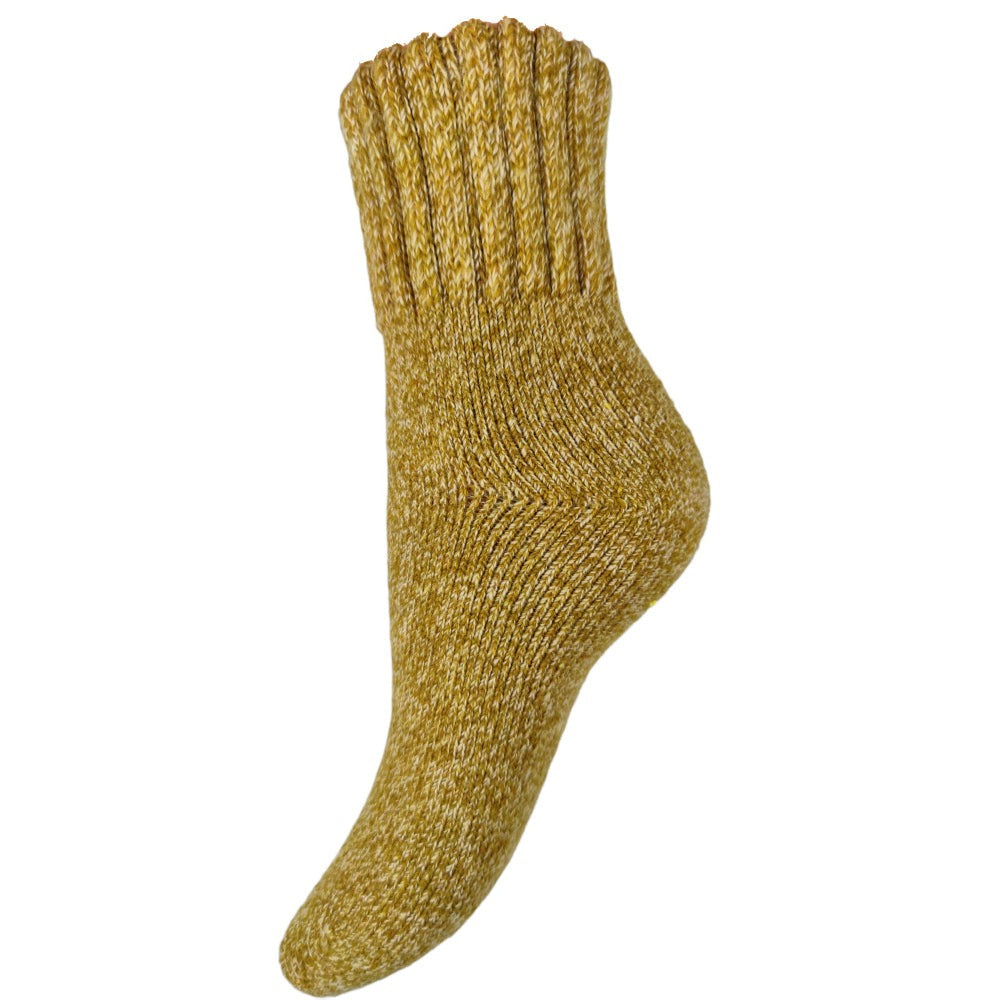
For a practical test, rub the sock against the inside of your wrist. Quality wool should feel soft rather than prickly, and the fabric should stretch back into shape. Our thick mustard wool blend socks are designed for warmth in boots and beds, and our three pairs of plain wool blend socks in sizes 4-7 suit lighter everyday wear.
Construction Checks: Knit, Cushioning, Reinforcement, and Fit
Construction is where cheap socks fail first, and it is the part of quality you can actually test before buying.
1. Knit density and consistency. Hold the sock up to a light source.
2. Stretch recovery. Gently stretch the cuff and the body of the sock sideways, hold for a few seconds, and release.
3. Heel and toe reinforcement. Turn the sock inside out.
4. Cushioning placement and density. Squeeze the sole between thumb and fingers. Good cushioning feels firm and springs back; poor cushioning feels either flat or spongy and slow to recover.
5. Pilling and fiber-shedding check. Rub the surface of the sock briskly against itself or against a smooth dark fabric for several seconds.
6. Seam and join strength. Gently tug the toe seam and any linked joins. They should hold without opening or distorting.
7. Fit and sizing. Check the size range against your foot length, not your shoe size alone, sock sizing varies by brand.
8. Elastic recovery after wear. A practical field test: wear the sock for a day, wash it per the care label, and check whether the cuff and heel return to shape.
Durability, Care, and Cost Per Wear
A higher price does not guarantee quality, but cheap socks that need replacing every few months can cost more over time. Divide the price by the number of times you expect to wear a pair to estimate cost per wear. A sock that lasts a year of regular use can be better value than a cheaper pair that thins after a month.

Care helps extend lifespan. Wash wool on a gentle, cool cycle, avoid tumble drying, and lay socks flat to dry. For a step-by-step routine, see a simple care guide for washing wool blend socks. Heat and agitation are the main causes of felting and shrinkage. The wool blend socks in our range are listed with a 30-degree wash, and drying flat keeps them in shape.
Alpaca and Blended Options Compared
Alpaca fibre is naturally warm, soft and lightweight, and it is often blended with wool to improve feel and reduce weight. Alpaca-blend socks can feel luxurious, though they generally cost more than standard wool blends. Compare the blend ratios rather than the material name alone, and choose a combination that suits how you plan to wear the socks. For heavier use, see the durable boot socks for hiking buyer's guide.
Choosing the Best Wool Socks for Everyday Wear
For daily wear, prioritise comfort, breathability and a fit that stays put. Choose a blend with enough wool to regulate temperature, a fine knit for softness, and a snug cuff that holds the sock in place. Many people find a thinner pair suits office or indoor wear, while thicker boot socks are better for outdoor use in cold weather. To compare options for trips, see breathable socks for travel, compared.
Consider how many pairs you will rotate through. Having two or three pairs lets each one rest between wears, which helps them keep their shape.
Picking Your Next Pair of Gemjar Wool Socks
Once you know what to look for, choosing a pair becomes straightforward. Our thick mustard wool blend socks, available in men's and women's sizes, suit cold-weather boots and cosy evenings. For lighter everyday wear, our three-pair pack of ladies wool blend socks is available in pink, light grey and light blue. Browse the full collection to find the weight and fibre blend that fits how you live.
Frequently Asked Questions
What company makes the best wool socks?
No single brand is best for every person, because quality depends on fiber content, construction, and how you plan to wear the socks. Compare labels for the wool percentage, check reinforcement at the heel and toe, and read the fit notes. Gemjar's wool blend socks, such as the thick mustard ribbed-cuff pair in sizes 4-7 UK and 7-12 UK, are built for walking, boots and bed use, with a composition of 30% wool, 45% polyester, 5% nylon and 20% acrylic. Test a pair against your own needs before deciding which brand suits you.
How can you tell if socks are made of wool?
Check the fiber-content label on the packaging or inside the cuff. Wool will be listed by name, usually as wool, merino wool or a percentage of wool. Be cautious when a label says wool-style or wool-look, since these may be acrylic. Also rub a small area: real wool feels slightly springy and warms up against the skin, while synthetic fibers often feel smoother and slippery. The percentage tells you how much wool is in the blend, so a 30% wool sock will behave differently from a 100% wool sock.
Are merino wool socks better than regular wool socks?
Merino wool socks usually feel softer and less itchy because merino fibers are finer than those of most regular wool. Finer fibers also tend to wick moisture well and regulate temperature, which makes merino a good choice for next-to-skin wear. Regular wool is often more robust and less expensive, so it can suit boot socks and rougher use. The better choice depends on whether softness or durability matters more to you.
Are 100% wool socks better than wool-blend socks?
100% wool socks offer natural breathability and warmth, but they often cost more and can wear faster in high-friction areas. Wool-blend socks add nylon or polyester for stretch, shape retention and abrasion resistance, which can extend the life of the sock. Blends are generally the better choice for everyday wear and boots, while pure wool suits people who prioritise natural fibers and are willing to care for them more carefully.
How can you tell whether wool socks are durable?
Look for reinforced heels and toes, a tight and even knit, and a fiber blend that includes nylon for abrasion resistance. Check the cuff: a ribbed cuff with good elasticity usually holds its shape better than a loose one. Examine the seams for neat, flat stitching without loose threads. Durable socks also tend to be made from a thicker yarn that does not look thin when stretched. Finally, follow the care instructions, because heat and tumble drying shorten sock life.
Are alpaca wool socks warmer than merino wool socks?
Alpaca fibers are hollow, which traps air and can make alpaca socks very warm for their weight. Merino is warm too, but it is lighter and better at moving moisture away from the skin. Alpaca is often softer and less likely to feel scratchy, though it can be more expensive. For very cold conditions alpaca may feel warmer, while merino suits active use where moisture control matters more.
What should you look for when buying wool socks?
Start with the fiber-content label and aim for a clear wool percentage. Check the construction: reinforced heel and toe, a snug but not tight cuff, and seams that lie flat. Pay attention to the sock weight so it matches your use, with thinner socks for daily wear and thicker ones for boots or cold weather. Make sure the size range matches your foot, as socks that bunch or slip down tend to wear out sooner.
What are the best wool socks for everyday wear?
For everyday wear, look for a wool-blend sock with a medium weight, reinforced heel and toe, and a fitted cuff that stays up during the day. A blend that includes some nylon or polyester usually lasts longer than pure wool under daily friction. Gemjar's plain wool blend three-pack in sizes 4-7 UK, which includes pink, light grey and light blue pairs, is a practical option for daily rotation. The three-pair pack is listed as suitable for a 30-degree wash and should not be tumble dried.

